|
By Dr. Boyan Bonev © 2003 University of Nottingham Eng-Phys, MSc, PhD, P Phys, MRSC and Catherine Cartwright-Jones 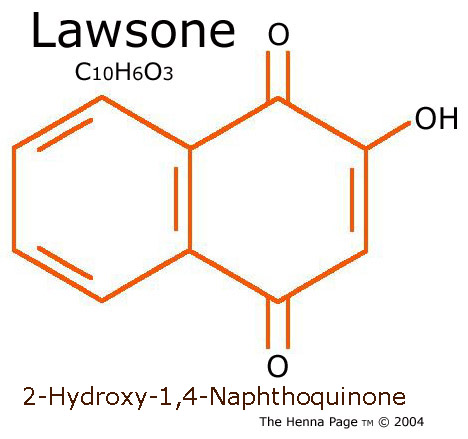 Henna, Lawsonia inermis, contains a red-orange pigment, lawsone, the molecule of which is also known as hennotannic acid. When henna leaves are crushed in an acidic medium and applied to skin, the lawsone molecules migrate from the henna paste, traverse the outermost layer of the hair, the cuticle and stain the hair. Prolonged applications of henna result in diffusion of the pigment deeply into the hair. Chemically, the molecule of lawsone is 2-hydroxy-1, 4-naphthoquinone. Industrial classifications also describe lawsone as Natural Orange 6 and C.I. 75480. The name and molecular structure (see picture) of lawsone show its congeniality to naphthalene. In lawsone, two oxygen atoms are attached to the naphthalene carbons at positions 1 and 4 to form 1,4-naphoquinone and a hydroxyl (–OH) group is present at position 2. Its molecule contains 10 carbons, 6 hydrogens and 3 oxygens (C10H6O3), giving a total molecular weight of 174.16 atomic units of mass. Pure lawsone is an orange powder, insoluble in water, with a melting point higher than 192ºC and optical absorption maximum of 452 nm. (All physical data on lawsone are taken from the Aldrich Chemical Database.) The size of the lawsone molecule, approximately 6.5x5x1.3 Å, compares to that of naphthalene. It is slightly bigger than the amino acids, the building blocks of proteins, and is slightly smaller than that of the sugar (sucrose) molecule. This is rather small in comparison to the size of biologically important molecules like proteins, containing typically hundreds or thousands of amino acids or even to phospholipids (8x8x40Å), which are major constituents of the membranes of cells and are also present in the top layer of skin Stratum corneum. Henna stains on hair darken during the first 48 hours after paste removal. If keratin is saturated with lawsone, under certain conditions the darkening can be dramatic. Only HPLC chromotography done in a certified independent laboratory will tell you what the lawsone content is in henna. Henna from mehandi.com has laboratory certified lawsone content. Want to know more about how henna dyes your hair? Read "The Chemistry of Henna." |